


Standing at the dock, watching a 200,000-ton vessel rest quietly against the pier, my child asked the million-dollar question: “Mom, if they only use a few ropes to tie up such a huge ship… what if the ropes break?”
Honestly, it stumped me. Later, while visiting the showroom of Yangzhou Lida Rope Technology Co., Ltd. , I found the answer. The “string” we use at home and the “mooring lines” holding a vessel are from two different universes.
Why Does Ordinary String Snap?
Everyday ropes rely on simple twisting—fibers rolled together like a braid. Under stress, force concentrates on weak points. Snap. Game over.
1. Material Revolution: From Hemp to “Soft Steel”
Forget Manila hemp. Modern high-performance ropes use UHMWPE or Nylon multifilament.
Real Data from Lida’s Lab:
- A 56mm diameter high-performance rope has a Minimum Breaking Load (MBL) of 135 tons (tested peak >150 tons). That’s lifting a train carriage.
- For large vessels, 160mm diameter ropes achieve breaking strengths of up to 2,000 tons.
Holding a 100,000-ton vessel is simply part of the job description.
2. The Wisdom of Braiding: Weaving a Web, Not Twisting a Thread
At Yangzhou Lida, we don’t just twist; we engineer the braid.
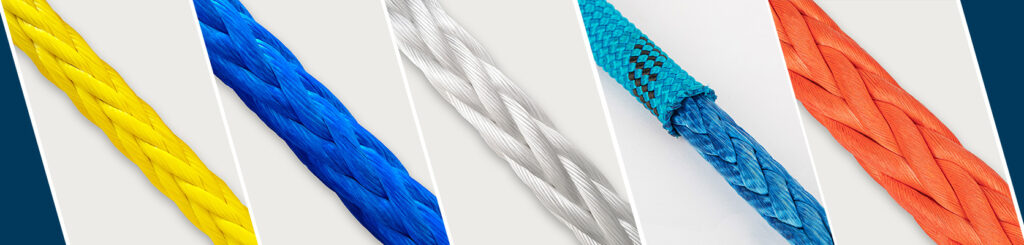
Using 8-strand cross-braiding technology, the load is distributed three-dimensionally across a network of fibers. Like a bundle of chopsticks, the structure holds firm even if the outer surface shows wear.
3. The Secret of Give-and-Take: Elasticity Saves the Ship
A rigid rope breaks the ship. A smart rope stretches.
Key Metric: Elongation at Break.
Lida’s Nylon ropes offer 15%-20% elongation. When a gust hits, the rope “gives” slightly, converting deadly kinetic energy into elastic potential—absorbing the shock like a martial artist.
For high-risk vessels like LNG carriers, Lida provides Tail-Compensating Combination Lines. A high-strength core (low stretch) bears the load; an elastic tail (Nylon) absorbs the shock. Studies show this can reduce peak line tension by up to 70%.
4. A Humbling Danger: The Snap-Back Zone
A rope under 100+ tons of tension stores lethal energy. Upon failure, it retracts at 120 meters per second—faster than a bullet. Years ago, a 56mm line snapped on a cruise ship, striking a crew member in the face. Investigation showed internal aging had reduced the actual breaking strength to just 69.8 tons, while the exterior looked new.
This is why Yangzhou Lida never engages in a race to the bottom.
- There is no room for chance in the breaking load of a rope.
- Safety must return to its essence: Reliability.
Pay for the data of fatigue resistance. Value the craft of zero-defect manufacturing.
Next time you see a taut mooring line at the port, look closely. It is not a silent tool. It is Yangzhou Lida Rope Technology wrestling the wind and waves on your behalf.
#YangzhouLidaRope #MooringLines #ShipSpareParts #MarineSafety #UHMWPERope #NoCompromiseOnQuality